
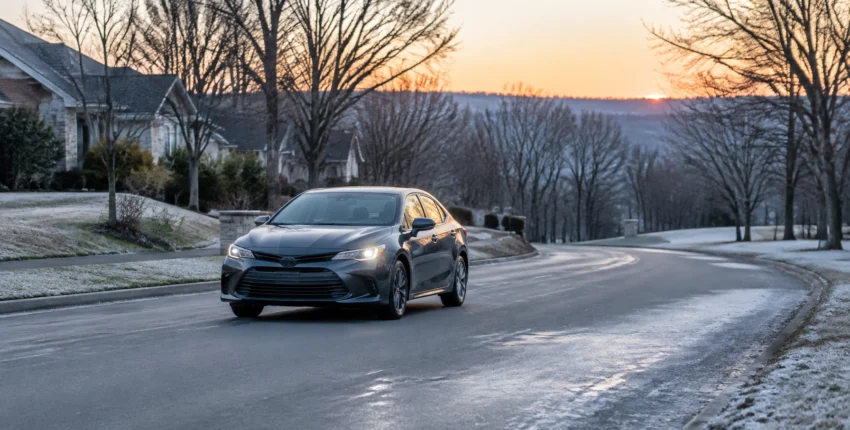
Arkansas winters are usually mild compared with places that deal with months of deep snow. That raises a fair question for drivers in Springdale, AR: Do you really need winter tires, or are all-seasons good enough?
For most people who drive primarily around town, a quality set of all-season tires with good tread, proper inflation, and plenty of rubber age remaining is usually a sensible choice. Dedicated winter tires are not an automatic requirement here.
But “mild winter” does not mean “no winter traction concerns.” Freezing morning temperatures, black ice, cold rain, icy bridges, and untreated shaded roads can create dangerous conditions even when there is little or no snow on the ground.
The deciding factor is not snow depth. It is temperature.
The 45°F question: why temperature matters more than snow
Below roughly 45°F (7°C), many all-season tire compounds begin to harden. As the rubber becomes less flexible, it cannot conform to the road as effectively. Grip can decrease on cold, wet, icy, and even dry pavement.
Winter tires use a softer compound designed to stay flexible in cold weather. Their tread also includes deeper grooves and more siping, small cuts in the tread blocks that create additional biting edges on ice and packed snow.
That difference matters during the first drive of the morning, especially when:
- A shaded road has frozen overnight
- A bridge or overpass is colder than the surrounding pavement
- Rain has turned into a thin layer of ice
- You need to stop suddenly at an intersection
- A hill requires extra traction to climb or descend safely
Research from AAA’s winter tire guidance and Michelin’s tire education resources explains why winter tires can offer better cold-weather grip even when roads are not covered in deep snow.
That does not mean every driver in Springdale needs a second set. It means the tire label is only one part of the decision.
All-season tires: the practical choice for many Springdale drivers
All-season tires are designed to handle a broad range of moderate conditions. They generally provide a quieter ride, longer tread life, and lower overall ownership cost than dedicated winter tires.
They make sense for drivers who:
- Mostly drive short distances around town
- Can avoid driving during the worst ice or snow
- Have newer tires with healthy tread depth
- Do not regularly leave home before roads are treated
- Prefer not to store and swap a second set of tires
A good all-season tire can perform well through much of a typical Springdale year. It is also more comfortable to leave on the vehicle year-round than a winter tire, which can wear quickly when used on warm pavement.
However, “all-season” does not mean “equally capable in every season.” Standard all-seasons are a compromise. They are built to be acceptable in many conditions, not exceptional in severe cold, ice, or snow.
If your current all-seasons are worn, hardened with age, or unevenly worn, replacing them with another set of the same category will not automatically solve the problem. Tire condition matters as much as tire type.
Winter tires: when the extra grip is worth it
Winter tires are engineered specifically for cold-weather performance. Their compound remains softer at low temperatures, while their tread pattern uses more siping and deeper grooves to improve traction on ice, slush, and snow.
The biggest benefit is not simply getting moving. It is maintaining control while braking and steering.
In cold conditions, winter tires can produce significantly shorter stopping distances than all-season tires. That extra margin may be especially valuable when a vehicle encounters black ice or a slick bridge unexpectedly.
Dedicated winter tires are worth considering if you:
- Drive before sunrise or late at night throughout the colder months
- Have a long commute that cannot be postponed
- Frequently travel over hills or shaded roads
- Need to drive regardless of freezing rain or occasional snow
- Carry passengers and want the greatest cold-weather traction available
- Have previously experienced repeated sliding or poor grip with all-seasons
The trade-off is cost and convenience. You need a second set of tires, and possibly a second set of wheels. Winter tires also wear faster in warm weather, may produce more road noise, and can feel softer or less precise on dry pavement.
They should be removed when temperatures remain consistently warm. Using them through the entire year wastes the tread designed for cold conditions and may leave you with less winter performance the following season.
All-weather tires: the middle ground
All-weather tires are different from traditional all-season tires. The most important feature to look for is the 3PMSF symbol, the Three-Peak Mountain Snowflake symbol that shows a snowflake inside a three-peak mountain.
That marking indicates the tire meets a recognized severe-snow traction standard. It does not make an all-weather tire identical to a dedicated winter tire, but it generally gives the tire better cold-weather and snow performance than a standard all-season model.
All-weather tires may be a good fit if you:
- Want stronger winter performance without seasonal tire changes
- Occasionally drive in snow, ice, or freezing rain
- Need one tire set for the entire year
- Do not have convenient storage for winter tires
- Want a compromise between all-season convenience and winter traction
The compromise is that all-weather tires may be noisier than standard all-seasons and may not last quite as long. They also will not usually match a dedicated winter tire on severe ice or deep snow.
For many drivers who want more cold-weather confidence without managing two sets, a quality 3PMSF all-weather tire can be a reasonable option.

Which one are you?
The best choice depends on how and when you drive, not on what sounds most capable in a tire advertisement.
“I take short trips around town”
A quality all-season tire is probably enough if your vehicle has good tread and you can stay off the roads during the worst conditions. Keep in mind that short trips often happen during the coldest part of the morning, so inspect the tires rather than assuming they are fine.
“I drive the highway regularly”
Highway speeds reduce your margin for error when traction is limited. If you drive early, travel long distances, or cannot delay trips during freezing conditions, winter or 3PMSF all-weather tires deserve serious consideration.
“I start work very early”
This is one of the strongest cases for upgrading winter traction. Roads that look merely damp later in the day can be icy before sunrise. Winter tires may provide a meaningful advantage when temperatures are below freezing and you must leave on schedule.
“I deal with hills”
Hills expose weak traction quickly. A tire that feels acceptable on level pavement may struggle when accelerating uphill or braking downhill. If hills are part of your regular route, tire condition and cold-weather design become more important.
“Rain is my main concern”
All-weather or winter tires can improve confidence on cold, wet pavement, but tread depth and alignment are still critical. A worn tire cannot evacuate water effectively, regardless of its category.
The costs people actually worry about
The price of winter tires is only part of the calculation. Consider the full ownership picture:
- Purchase cost: Winter tires require a separate set, while all-season tires require only one.
- Storage: You need a clean, dry place away from direct heat and sunlight.
- Seasonal swapping: Dedicated winter tires usually mean changing sets twice a year.
- Road noise: Winter and some all-weather tires may be louder.
- Tread wear: Winter compounds wear quickly on warm pavement.
- Convenience: All-season tires are simpler if your winter driving is limited.
- Safety margin: Winter tires can provide more grip when conditions are genuinely cold and slippery.
If you choose winter tires, install all four. Never put winter tires on only the front or rear axle. Mixing two winter tires with two all-season tires can create an imbalance in braking and cornering grip, making the vehicle harder to control.
Tread depth and age matter more than the label
A tire’s category cannot compensate for worn or aged rubber.
The legal minimum tread depth is generally 2/32 of an inch, but that is not the same as a comfortable safety margin in wet or winter conditions. At around 4/32 of an inch, wet-weather performance can be significantly reduced, and the tire has less tread available to channel water or provide biting edges.
Tire age matters, too. Many tire manufacturers and industry professionals use six years as an important replacement guideline, even when the tread appears acceptable. Rubber hardens over time, and that loss of flexibility becomes more noticeable in cold weather.
Check the tire’s date code on the sidewall, and look for:
- Cracks in the sidewall or between tread blocks
- Uneven wear across the tread
- Bulges or impact damage
- Repeated loss of air
- Vibration or pulling while driving
- Noticeably reduced grip in rain or cold weather
If you are unsure, a professional inspection can measure tread depth and check the tire’s overall condition.
Tires need a healthy vehicle underneath them
Cold-weather traction is not just about the rubber touching the road. Worn suspension components, loose steering parts, and poor alignment can keep the tire from maintaining consistent contact with the pavement.
Misalignment may cause uneven tread wear, while worn suspension parts can affect stability during braking and cornering. That is why a tire recommendation should sometimes lead to a broader inspection, not an unnecessary upsell, but a clear look at the systems responsible for holding the tire to the road.
ASAP Automotive Service & Performance provides wheel alignment services in Springdale, AR and can inspect suspension-related concerns as part of a larger maintenance visit. Our digital vehicle inspections include photo documentation and regular updates, so you can see what the technician sees before deciding how to proceed.
With more than 15 years of experience, our ASE-certified mechanics provide dealership-quality work for all makes and models. We take time to listen, explain the options, and provide honest pricing without unnecessary upselling. Same-day service may be available depending on the schedule, and flexible financing options through Koalafi and Synchrony can help manage unexpected repair costs.
The honest answer for Springdale drivers
For most drivers who mainly travel around Springdale and can avoid icy roads, good all-season tires are usually sufficient. If you regularly drive early in the morning, face hills, cannot postpone winter trips, or want the strongest cold-weather braking performance, dedicated winter tires may be worth the added cost and inconvenience.
A 3PMSF all-weather tire is the practical middle option for drivers who want improved winter capability without swapping tires twice a year.
Before choosing, look beyond the label. Check the tire’s age, tread depth, condition, and wear pattern. Then make sure the alignment and suspension are helping, not hurting, the tire’s contact with the road.
If you need help choosing tires or want your current set inspected, book online with ASAP Automotive or call 479-750-4017. We will help you choose a solution that fits your vehicle, driving habits, and winter needs in Springdale, AR.