
When most people hear “dyno tuning,” they picture a heavily modified race car, a loud exhaust, and a driver chasing the biggest horsepower number possible. That image is understandable, but it leaves out a large part of the story.
Dyno tuning can also benefit everyday vehicles. For drivers in Springdale and throughout Northwest Arkansas, a properly calibrated tune may improve throttle response, drivability, fuel efficiency, and overall engine operation. It is not a magic solution for every vehicle, and it cannot replace necessary repairs or maintenance. However, when performed with the right equipment and a clear understanding of the vehicle’s goals, dyno tuning can make a daily driver feel smoother, more responsive, and better matched to the way you use it.
What Is Dyno Tuning?
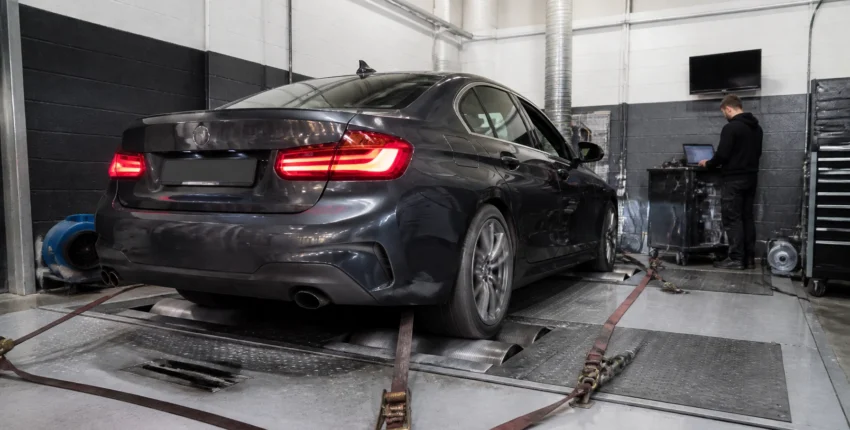
Dyno tuning uses a dynamometer, often called a dyno, to measure how an engine performs under controlled load. With a chassis dynamometer, the vehicle’s driven wheels rest on rollers while the vehicle is secured in place. Technicians can then monitor engine data as the vehicle runs through different speeds and operating conditions.
Depending on the vehicle, the tuning process may involve adjusting settings such as:
- Fuel delivery
- Ignition timing
- Throttle mapping
- Boost control on turbocharged or supercharged engines
- Load and RPM targets
- Air-fuel ratios
The purpose is not simply to make the engine produce more power. A professional tune should match the vehicle’s mechanical condition, modifications, fuel, and intended use.
At ASAP Automotive Service & Performance, our precision dyno tuning service uses an AWD Dynocom 15,000 series chassis dynamometer. This allows our technicians to evaluate vehicle performance with measurable data rather than relying on guesswork or a generic tune.
Why Daily Drivers Can Benefit From a Dyno Tune
A daily driver does not need an aggressive race setup to benefit from careful calibration. In fact, many drivers are more interested in how their vehicle behaves during normal use than in its peak horsepower figure.
The most useful improvements often show up during commuting, merging, climbing hills, or navigating stop-and-go traffic.
1. Smoother, More Predictable Drivability
A vehicle that hesitates when you press the accelerator, surges at steady speed, or feels inconsistent under load can become frustrating to drive. These symptoms may be related to calibration, but they can also point to mechanical or electrical problems.
A dyno session helps technicians observe how the engine behaves across a range of operating conditions. If the vehicle is mechanically sound, adjustments may improve the consistency of power delivery and reduce flat spots or hesitation.
For a daily driver, that can mean:
- Smoother acceleration
- More consistent power on hills
- Less hesitation when merging
- Better response when carrying passengers or cargo
- A more refined feel in ordinary traffic
The difference may not be dramatic in a parking lot. It is often more noticeable on the road, where the engine is asked to respond smoothly and repeatedly.
2. Improved Throttle Response
Throttle response describes how quickly the engine reacts after you press the accelerator. A delay or soft spot can make a vehicle feel sluggish, even when the engine is producing adequate power.
A precision tune may sharpen throttle mapping and improve how the engine responds at low and mid-range RPMs. This does not necessarily make the vehicle harsh or difficult to control. The goal for a street-driven vehicle is usually a response that feels immediate but still smooth.
That can be especially helpful around Northwest Arkansas, where daily driving may include city traffic, highway entrances, steep grades, and frequent changes in speed. Better response can make the vehicle feel easier and more confident to drive without turning it into a race car.
3. More Efficient Fuel Use
Fuel economy depends on much more than software. Tire pressure, alignment, driving habits, vehicle weight, maintenance, fuel quality, and engine condition all play a role.
Still, an engine that is not operating efficiently may waste fuel. A dyno tune can help identify areas where fuel delivery and ignition timing are not well matched to the vehicle’s setup. When the engine is running properly and the calibration is appropriate, combustion may become more efficient across certain driving conditions.
That does not mean every vehicle will suddenly gain a large amount of fuel economy. A stock vehicle in excellent condition may see only modest changes. For some owners, the main benefit will be smoother operation rather than a major increase in miles per gallon.
The potential value is often greater when a vehicle has aftermarket modifications, changed fuel requirements, or an existing drivability concern. Any fuel-economy improvement should be viewed as a possible benefit, not a guarantee.
Dyno Tuning Is Not a Substitute for Engine Repair
This distinction is important.
If your vehicle has a misfire, vacuum leak, failing sensor, weak fuel pump, overheating issue, or internal engine problem, tuning should not be used to hide the symptom. Adjusting the calibration before resolving the underlying fault may make diagnosis more difficult or place additional stress on the engine.
A responsible tuning process begins with a vehicle that is in suitable mechanical condition. That may include checking:
- Engine oil and coolant levels
- Spark plugs and ignition components
- Fuel pressure and delivery
- Intake and vacuum systems
- Sensors and wiring
- Cooling system operation
- Existing diagnostic trouble codes
- Signs of abnormal noise, smoke, or overheating
This is where choosing a full-service shop matters. If you are searching for engine repair in Springdale, AR, you want technicians who can determine whether your vehicle needs a repair, a tune, or both.
ASAP Automotive provides comprehensive inspections and repairs before performance adjustments are recommended. Our engine repair services are designed to restore power and efficiency when a mechanical issue is the real cause of poor performance.
How Digital Vehicle Inspections Fit Into the Process
A digital vehicle inspection gives you a clearer view of your vehicle’s condition. Instead of receiving a vague recommendation, you can receive documented information about what technicians found, including photo documentation and updates during the service process.
That transparency is valuable before a dyno session. It helps answer practical questions:
- Is the vehicle healthy enough to tune?
- Are there worn components that should be addressed first?
- Are leaks, damaged wiring, or maintenance issues affecting performance?
- Which improvements are realistic for the vehicle’s current condition?
At ASAP Automotive, our technicians use advanced diagnostic tools and digital inspections to evaluate vehicle health. We take time to explain the findings and provide tailored recommendations, so you can make an informed decision rather than paying for work you do not need.
When Dyno Tuning Makes the Most Sense
Dyno tuning is often a strong option in the following situations.
After Performance Modifications
If you have installed an intake, exhaust components, headers, upgraded injectors, forced induction, or other performance parts, the factory calibration may not be optimized for the new setup.
A dyno tune can help the engine and its supporting systems work together more effectively. It may also reveal whether a modification is creating an air-fuel or performance issue that is not obvious during normal driving.
When Drivability Is Inconsistent
Hesitation, surging, poor response, or inconsistent power should be diagnosed carefully. In some cases, the cause is mechanical. In others, a calibration issue may be contributing.
Testing under controlled load gives technicians useful information that may not appear during a short road test.
When You Want a More Personalized Driving Experience
Some owners want a vehicle that feels calmer and smoother during commuting. Others want stronger mid-range response for highway driving or more precise throttle control on weekend roads.
Dyno tuning can be tailored to the vehicle’s purpose. A daily-driver tune should prioritize reliability, smoothness, and usable performance, not simply the highest possible output.

What About Engine Longevity?
A proper tune cannot guarantee that an engine will last longer. Vehicle age, maintenance, driving conditions, and mechanical quality remain major factors.
However, an appropriate calibration can help an engine operate more consistently. Avoiding excessively rich or lean conditions, abnormal combustion, and unnecessary heat can support reliable operation. That is particularly important on modified vehicles, where factory settings may no longer suit the parts installed.
The key is moderation and precision. A tune designed for a daily driver should respect the limits of the engine, transmission, fuel system, and cooling system. More power is not always better if it comes at the expense of reliability.
Choosing a Dyno Tuning Shop in Northwest Arkansas
Before scheduling, ask how the shop approaches the process. A trustworthy provider should be willing to discuss your vehicle’s condition, modifications, fuel, goals, and expected results.
Look for a shop that:
- Uses professional dyno and diagnostic equipment
- Checks vehicle health before tuning
- Explains what adjustments are being made
- Provides honest, transparent pricing
- Focuses on drivability and reliability, not just peak numbers
- Can handle related repairs if an issue is discovered
ASAP Automotive Service & Performance combines precision dyno tuning with complete automotive care. Our ASE-certified mechanics bring more than 15 years of industry experience to repairs, inspections, and performance work. We also offer same-day service availability for many automotive needs, convenient online booking, and flexible financing options through approved partners when an unexpected repair requires more planning.
Whether you need a tune, a diagnostic evaluation, or dependable auto repair in Springdale, AR, our team will explain the options clearly and help you choose a practical path forward.
Is Dyno Tuning Worth It for Your Daily Driver?
For many drivers, yes: but the value depends on the vehicle and your goals.
A stock vehicle that already runs perfectly may see modest gains. A modified vehicle, a high-mileage commuter, or a car with inconsistent drivability may benefit more noticeably. In either case, the best results come from a careful process that puts mechanical health first and uses real data to guide adjustments.
Dyno tuning is not only for race cars. Done correctly, it can help a daily driver feel smoother, respond more naturally, use fuel more efficiently in certain conditions, and operate with a calibration suited to its specific setup.
If you want to find out whether dyno tuning is a smart choice for your vehicle, schedule an appointment with ASAP Automotive Service & Performance in Springdale. We’ll inspect your vehicle, listen to your goals, explain the costs upfront, and help you get more from every drive throughout Northwest Arkansas.